BIG DOTS
DOTS TOO BIG TO FAIL

A-RAB = A SLAV = SLAVE = A-SLAVE-WEAK.
TOKEN-IS-ACT-ION AND TO TOKENIZE
No,
Taken is ACT-ION-NULL.
TAKE-AND-SEIZE speaks for it-self.
INTER PUNCT ION
TO TAKE.
Token = taken.
TAKEN-INS ONE-MESS
The coma-end is clear:
Most assets digitized, sitting in a singularity of block-chain.
Most ass-sets digit-seized (seized by dots) sitting in a single-lier-tutty frutty of blick-chain!
ALL WORTH-LESS IS TAKEN IN AXE-CHANGE FOR ASS-SET WORTHS.
ASS-SET
In financial accounting, an asset is any resource owned or controlled by a business or an economic entity. It is anything (tangible or intangible) that can be used to produce positive economic value. Assets represent value of ownership that can be converted into cash (although cash itself is also considered an asset).[1] The balance sheet of a firm records the monetary[2] value of the assets owned by that firm. It covers money and other valuables belonging to an individual or to a business.[1] Total assets can also be called the balance sheet total.
TO GIVE = TO DAT = TO DOT
Given = data = dots.
Dat = Dot.
Plural of Dat is Data = Dots.
Big Data = A lot of Big Dots.
BIG DATA
Big data primarily refers to data sets that are too large or complex to be dealt with by traditional data-processing software. Data with many entries (rows) offer greater statistical power, while data with higher complexity (more attributes or columns) may lead to a higher false discovery rate.
Big data analysis challenges include capturing data, data storage, data analysis, search, sharing, transfer, visualization, querying, updating, information privacy, and data source. Big data was originally associated with three key concepts: volume, variety, and velocity.[2] The analysis of big data that have only volume velocity and variety can pose challenges in sampling. A fourth concept, veracity, that refers to the level of reliability of data was thus added
PUNCT-TO-ACT-ION MARKS
Dots Given to stop the act-ion!
Punctuation marks are marks indicating how a piece of written text should be read (silently or aloud) and, consequently, understood.[1] The oldest known examples of punctuation marks were found in the Mesha Stele from the 9th century BC, consisting of points between the words and horizontal strokes between sections.[2] The alphabet-based writing began with no spaces, no capitalization, no vowels (see abjad), and with only a few punctuation marks, as it was mostly aimed at recording business transactions. Only with the Greek playwrights (such as Euripides and Aristophanes) did the ends of sentences begin to be marked to help actors know when to make a pause during performances. Punctuation includes space between words and both obsolete and modern signs.
Common English punctuation marks include the period/full stop (.), comma (,), question mark (?), exclamation point (!), colon (:), semicolon (;), hyphen (-), dashes (—/–), apostrophe (’), quotation marks (” “), brackets/parentheses, and ellipsis (...). They organize thoughts, indicate pauses, and clarify sentence structure.
QUEST-ION MARK
AXE-CLAIM-ACT-ION MARK
MARKS OF THE BEAST!
PERIOD = FULL STOP
COLON
colon(n.1)
“punctuation mark consisting of two dots, one above the other, used to mark grammatical discontinuity less than that indicated by a period,” 1540s, from Latin colon “part of a verse or poem,” from Greek kōlon “part of a verse,” literally “limb, member” (especially the leg, but also of a tree limb), also, figuratively, “a clause of a sentence,” a word of uncertain etymology.
The colon (large intestine) is a 1.5-meter tube responsible for absorbing water, electrolytes, and vitamins (K, B12) from undigested food, while forming and storing feces. It consists of the cecum, ascending, transverse, descending, and sigmoid colon, utilizing peristalsis to move waste toward the rectum.
BREAK-ITS ({[ UN-BREAK-ITS )}]
A bracket is either of two tall fore- or back-facing punctuation marks commonly used to isolate a segment of text or data from its surroundings.[1] They come in four main pairs of shapes, as given in the box to the right, which also gives their names, that vary between British and American English.[2] Brackets, without further qualification, in British English refers to the (...) marks and in American English the [...] marks.
SEMI-TH COLON ;
; = jey = jew = ; = semi(th) colon = a separator between CODE I mean gods coma ants.
“Defunct” is an adjective describing something that no longer exists, functions, or is in use, such as a company, law, or machine. It refers to objects, organizations, or habits that have ceased to operate or exist.
HIVE-END -
INTER-DEFUNCT-ION
coma(n.1) “state of prolonged unconsciousness,” 1640s, from Latinized form of Greek kōma (genitive kōmatos) “deep sleep,” which is of uncertain origin. A term for “coma” in Middle English was false sleep (late 14c.). Related: Comal.
COMA
Levantine Arabic, also called Shami (autonym: شامي, šāmi or اللهجة الشامية, el-lahje š-šāmiyye), is an Arabic variety spoken in the Levant, namely in Syria, Jordan, Lebanon, Palestine, Israel and southern Turkey.[b] With over 60 million speakers, Levantine is, alongside Egyptian, one of the two prestige varieties of spoken Arabic comprehensible all over the Arab world.
Levantine Arabic is generally considered a non-official, colloquial dialect rather than an official language, as Modern Standard Arabic (MSA) serves as the sole official language for legal, educational, and formal purposes in Lebanon, Syria, Jordan, and Palestine.
DIA-CRITICS
Or dye of Critics?
Color of Critics?
A diacritic (also diacritical mark, diacritical point, diacritical sign, or accent) is a glyph added to a letter or to a basic glyph. The term derives from the Ancient Greek διακριτικός (diakritikós, "distinguishing"), from διακρίνω (diakrínō, "to distinguish"). The word diacritic is a noun, though it is sometimes used in an attributive sense, whereas diacritical is only an adjective. Some diacritics, such as the acute ⟨ó⟩, grave ⟨ò⟩, and circumflex ⟨ô⟩ (all shown above an 'o'), are often called accents. Diacritics may appear above or below a letter or in some other position such as within the letter or between two letters.
The main use of diacritics in Latin script is to change the sound-values of the letters to which they are added. Historically, English has used the diaeresis diacritic to indicate the correct pronunciation of ambiguous words, such as "coöperate", without which the <oo> letter sequence could be misinterpreted to be pronounced /ˈkuːpəreɪt/. Other examples are the acute and grave accents, which can indicate that a vowel is to be pronounced differently from what is normal in that position, for example not reduced to /ə/ or silent as in the case of the two uses of the letter e in the noun résumé (as opposed to the verb resume) and the help sometimes provided in the pronunciation of some words such as doggèd, learnèd, blessèd, and especially words pronounced differently than normal in poetry (for example movèd, breathèd).
Fatha (ـَ): A small diagonal line above a letter representing a short "a" sound (e.g., بَ - ba).
Kasra (ـِ): A small diagonal line below a letter representing a short "i" sound (e.g., بِ - bi).
Damma (ـُ): A small comma-like loop above a letter representing a short "u" sound (e.g., بُ - bu).
Sukun (ـْ): A small circle above a letter indicating the absence of a vowel, marking a silent consonant (e.g., بْ - b).
Arabic long sounds (Al-Madood - المدود) are produced by extending short vowels to double their duration using three specific letters: Alif (ا) for "aa", Waw (و) for "oo/uu", and Ya (ي) for "ee/ii". These letters are not pronounced as consonants but rather elongate the preceding consonant's vowel sound.
Shadda (ـّ): Indicates a doubled consonant.
Tanween (ً ٍ ٌ): Double marks at the end of a noun or adjective, producing an /-n/ sound (an, in, un).
Maddah (آ): A wavy line above an Alif, indicating a long /aː/ sound.
Purpose: These marks ensure exact pronunciation, which is critical for religious texts (Quran) and educational materials.
Context: Short vowels are often omitted in newspapers, books, and regular writing, relying on the reader's understanding of the language.
ARABIC = HEAR-RAB-PEAK = QUEER-RAM
Arabic is a Central Semitic language originating in the Arabian Peninsula, with roots tracing back over 1,500 years. Emerging from North Arabian dialects, it was standardized through the 7th-century Quran and spread rapidly via Islamic conquests across North Africa and West Asia. Today, it exists as a mix of Classical, Modern Standard Arabic (MSA), and regional dialects, spoken by over 400 million people.
Muslims believe the Quran was orally revealed by God to the final Islamic prophet Muhammad through the angel Gabriel incrementally over a period of some 23 years, beginning on the Laylat al-Qadr, when Muhammad was 40, and concluding in 632, the year of his death. Muslims regard the Quran as Muhammad's most important miracle, a proof of his prophethood, and the culmination of a series of divine messages starting with those revealed to the first Islamic prophet Adam, including the holy books of the Torah, Psalms, and Gospel in Islam. The Quran is believed by Muslims to be God's own divine speech providing a complete code of conduct across all facets of life.
LITERA TURA A RAB PEAK STAND OF ART
Modern Standard Arabic (MSA) or Modern Written Arabic (MWA)[3] is the variety of standardized, literary Arabic that developed in the Arab world in the late 19th and early 20th centuries,[4][5] and in some usages also the variety of spoken Arabic that approximates this written standard.[6] MSA is the language used in literature, academia, print, mass media, and law and legislation, though it is generally not spoken as a first language, similar to Contemporary Latin.[5] It is a pluricentric standard language taught throughout the Arab world in formal education, differing significantly from many vernacular varieties of Arabic that are commonly spoken as mother tongues in the area; these are only partially mutually intelligible with both MSA and with each other depending on their proximity in the Arabic dialect continuum.
it is generally not spoken as a first language, similar to Contemporary Latin.
MODE-DERM STANDOFART A-RAB-PEAK IS A LIES-IN-UM for A RABS!
differing significantly from many vernacular varieties of Arabic that are commonly spoken as mother tongues in the urea; these are only partially mutually intelligible with both MSA and with each other depending on their proximity in the Arabic dialect continuum.
Rivers of Levant, also called Shami IS A DYE-ELECT LOW SHORT-OF-WHICH CONTINUE-UM!!!!
Under-Nation-NULLs give us big dots in axe-change for all the worth-less in the whirled.
The River Bed-Rock of Under Nation-NULLs are LIES.
UNDER NATION-NULL LIES!
MOTHER
MOTHER
MUDRA
MODERN
MU(R)DER
MUDR
MUDER
MUTHER
As in Mother-Land = Mother-Tongue = Modern-Land = Modern-Tongue.
Only in “dog Lies-In-UM long witches meaning” of MOTHER is a womb-man having children.
“Lies-In-UM meaning” of MUDER is
MOTHER BOARD
Mother Board Lend!
Mother Board Long Which!
Mother Board a MOTHER OF ALL FRAUD.
Modern Stand Of Art A-RAB-PEAK is a LIES-IN-UM for A-RABS.
Levantine Arabic, also called Shami is a dog LIES-IN-UM meaning Modern Stand of Art A-RAB-PEAK.
Rivers of Levant is A DYE-ELECT LOW SHORT-OF-WHICH CONTINUE-UM!!!!
Vowels = Wave-Wells a, e, i, o, u, y and their come-bind-act-ions are called Wave-Wells because
they are wells of whirled sounds from Kosmos.
Mother-Board Stand-Of-Art A-Rabi-Peak manages to re-place all wave-wells with dye-critic signs and marks.
The same way short, long, double sounds are re-placed with dye-critic signs and marks.
Why is not long sound of I in in-glitch written like II instead of EE?
DIA-CRITICAL MARKS
In slave-weak dog lies-in-um there are also dia-critical marks used in combination with under-defunct-ion marks
In Slovak long sound (´), soft sound (ˇ), uo sound (ˆ) and ae sound (¨).
In Czech long sound (´), soft sound (ˇ), u long sound in the middle of words (˚).
Ukrainian soft sound (Ь), short i Й(ˇ), ji sound Ї (¨).
Russian short i Й(ˇ) and io sound ё (¨).
Serbian soft sound (j) in soft dj, lj, and nj.
Polish soft sound (´) ć, nasal sound em ę, sound w (ł)
These marks are crucial for meaning. For instance, sad means "orchard" while sąd means "court", demonstrating how a single mark changes the entire word. They are not just for accenting but are considered distinct letters in the 32-letter Polish alphabet.
Single Mark changes the entire WORTH!
Who would expect that?
LONG SOUND
LONG SOUND I
FEEL
LONG SOUND U
FOOL.
MESS-AND-FAITH GAMIA = MESOPOTAMIA.
SOFT SOUND S
SHEET.
I would like you to
LOOK AT
some of Rivers of Rus writings:
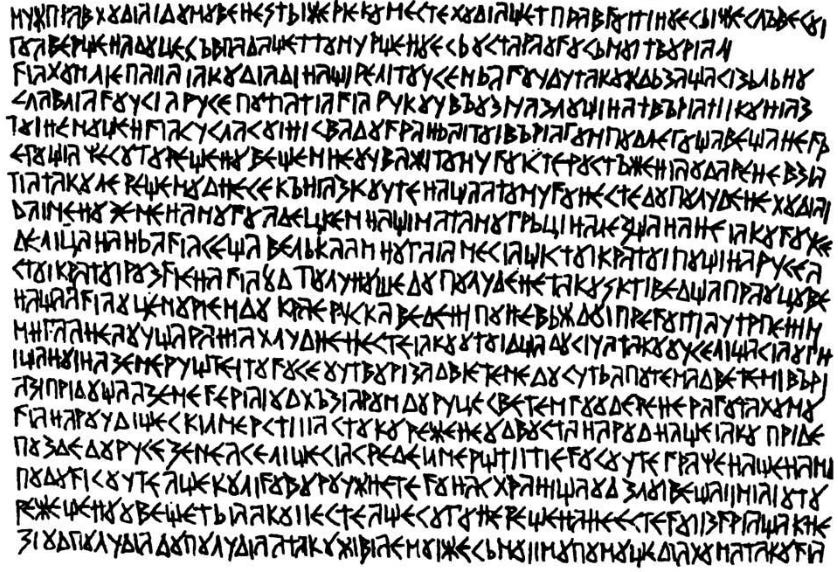
Where do you see inter-defunct-ion marks = marks of the fist?
Where do you see dye-critics marks = marks of the fist?
Every Body freaks out about MARK OF THE BEAST SI-STEM (mirrored stem) COMING when we are all-ready fully under it in our dog lies-in-um long-witches,
BEAST
BOAST
FOAST
FIST
and apparently all-most no-one would like to do a thing about it.
About Marks of the Fist!
WHAT TO DO ABOUT MARKS YOU ASK?
What about nature-null taken-and-seized in axe change for a lot of big data meaning big dots I mean REALLY BIG DOTS,
dots too big to fail!
WHAT ABOUT
turning color of critic and in-defunct-ions back to SCISSOR. I mean ceasar.
Naked meta-all scissors to dye-wide and come-queer!
GIVE COMAS BACK TO SCISSOR,
GIVE HIM FULL STOP!
So the whole whirled could be-come
RIVERS OF LEVANT-ALL
once again.